Author: Goldberg Jones – Divorce For Men

  • Signs They May Be Hiding Assets During Divorce

    With divorce looming on the horizon, it’s important to get your proverbial ducks in a row. Particularly when it comes to finances.

    During the process, you and your soon-to-be-ex need to provide records of income, assets, debts, and all the rest. These will then be divided according to the law based on various factors.

    You may be tempted to try to hide some of your valuables. That, however, has serious consequences if you’re found out, including fines, contempt charges, and even jail time.

    But what if your ex tries hiding assets? It’s all too common for people to squirrel treasures away when divorce is imminent. It can help protect your rights and your financial future if you know how to look for certain red flags.

    Signs They May Be Hiding Assets During Divorce

    This is not an exhaustive list by any means, but here are some common signs your ex might be hiding assets. These don’t automatically mean that’s the case, but if you see one or more of these, it might be worth closer examination.

    1. Self-Employment

    Being a business owner isn’t in and of itself a warning sign of hidden assets. That said, if your ex owns a business, it does provide creative opportunities to conceal money.

    Be wary of drastic changes in reported income and unexpected increases in operating costs.

    Purposely running a business into the ground may signal something is amiss. Not letting you access the business’s financial records may also tip you off.

    If either of you owns a business, it makes divorce that much more complicated. There are many specific concerns and potential consequences you face in that situation. It may even impact business partners. In these situations, it’s likely in your best interest to talk to an experienced professional.

    2. Income/Lifestyle Discrepancy

    If your ex lives large, but claims to have no money, or reports an income below the poverty line, that may indicate something is awry with the financial disclosure.

    If your ex buys a new car or vacations in Cabo, only to assert there’s no money, keep an eye open.

    Additionally, changes in how much or how often your spouse contributes to family expenses can be a warning sign of hiding assets.

    Related Reading: How Does Divorce Mediation Work?

    3. Changes in Deposit/Withdrawal Activity

    If you notice sudden changes in banking activity, it might be worth taking a closer look. Patterns shifting after years of consistency and predictability may indicate your ex has something to hide.

    It isn’t uncommon for spouses to make cash withdrawal or to start diverting money into new accounts when a divorce is inevitable.

    Cash transactions are more difficult to track. Thanks to this, it’s an attractive avenue for people trying to stash assets out of view. Once cash is removed from an account, it can be tucked away in any number of places until the divorce is final.

    Related Reading: Rebuilding Your Finances After Divorce

    4. Overly Assertive About Financial Documents

    If your ex insists you sign important financial documents immediately, it may signify an attempt to hide assets. Pressuring you to act quickly may be a strategy to get you to overlook something significant.

    This can encompass everything from wanting to be added to property via title or asking you to sign quitclaims that release interest in titles or accounts.

    Don’t give in to the pressure and don’t sign anything just because it’s easier. Take the time to read all documents. If you don’t understand them, find someone who does, the more experienced the better. This is important whether you think your ex is hiding assets or not. Either way, your financial future hangs in the balance, make sure to do things right.

    Related Reading: The Cost of Divorce in Washington

    5. Secretive About Finances

    Is your ex being secretive about finances or getting cagey when you ask about bills, expenses, income, or spending? Sure, some people don’t like to talk about money, but that may also be a red flag that someone is hiding assets.

    You can help yourself by paying close attention.

    Keep an eye on credit card statements and monitor credit reports before, during, and after divorce. Spouses commonly max out lines of credit or open new accounts.

    People often accumulate clothes, jewelry, and other expensive items on joint accounts. Depending on the situation, this debt may be divided in the divorce, and you may wind up on the hook.

    Related Reading: How to Split Debt in Divorce

    6. Sudden Change in Business Profitability

    Again, businesses offer a variety of ways for people to try to hide assets during a divorce. If a business has been profitable but then takes a sudden, drastic downturn, it may be a red flag.

    Keep an eye on reports of record losses or skyrocketing costs. This may require a closer look.

    Overstating expenses and understating income are two methods of making a business appear less profitable, and thus less valuable than it is in reality.

    Related Reading: How Is A Business Divided in A Divorce? Can You Protect It?

    7. Gifts

    Giving gifts of cash or assets to family members is a common way people try to hide assets in a divorce. If your spouse starts handing out money or property to friends or family before filing for divorce, those assets may be out of reach when it comes to the division of property.

    This is especially challenging when it comes to overseas relatives. Money held in offshore accounts can be particularly difficult to locate and even harder to recover. If you suspect your spouse is trying to hide assets in an offshore account, you may need to hire a detective who specializes in financial fraud.

    Related Reading: Is Inheritance Considered Separate Property in Divorce?

    8. Unfamiliar Financial Institutions

    Divorce or not, pay attention to bank statements, credit card bills, and other financial documents. That’s just basic money management.

    If you start seeing documents from financial institutions where you don’t have accounts, take note. This may indicate your spouse opened new accounts and is trying to move funds from joint accounts to one you can’t access.

    Finances are complex under normal circumstances. As with most things, divorce only further complicates the matter.

    If you suspect your spouse is hiding assets, it’s vital to consult a professional. An experienced divorce attorney knows what to look for, how to handle these situations, and can help secure your financial well-being in the future.

    Related Reading: Moving Out During Divorce: What to Know *Before* You Go
  • Divorce After A Brief Marriage

    As a general rule, the longer the marriage, the more complicated the divorce. The other side of that coin is that in shorter marriages, ones without kids and with little shared property to divide, divorce can be relatively simple.

    But what about a really, really, really brief marriage?

    Our founding partner, Rick Jones, regularly stops by the Danny Bonaduce and Sarah Morning Show, where he talks all things family law. One caller realizes her new marriage isn’t a good fit and, rather than cling to something, wants to nip it in the bud.

    No matter the length of a marriage, the steps to begin the process remain the same. Along the way, other things pop up that take more time. Much more in some cases. But whether you’re talking about a quickie Vegas wedding or a 50-year union, it all starts in the same spot.

    Related Reading: Costs Of A Divorce In Washington State

    Listen to the Conversation About Brief Marriages Below:

    Caller: “I recently got married and realized it’s not working out; it’s not a great fit. How do I start the divorce process?

    Rick: “Well, first of all, I commend you for recognizing it’s not going to work out. So many times I’m hearing from somebody who’s ten, 15 years in and they say, ‘You know, I knew this wasn’t going to work out.’ The reason why I say that is from a legal perspective the issues are likely to be far more simple. My guess is there are no children involved?”

    Caller: “No.”

    Rick: “That also tells me that the finances are likely to be simpler as well. There hasn’t been an accumulation of community property. So the basic answer to your question of ‘How do you start this?’ is you file what’s called a Petition For Divorce with the court.

    “It starts the clock running, and as long as you two can come to an agreement within 90 days–90 days is the waiting period [in Washington State]–that’s when you can get this finalized.

    “There are a couple of ways to do it. Certainly, the best way is to hire an attorney. It shouldn’t be a hugely expensive venture because of the simplicity of it.

    “Another way to do it: there are several online options–especially ‘Washington Divorce Online‘–that are able to create and draft documents for you at an even lesser cost. And then thirdly, you can do this yourself.

    Danny: “So that’s for people that have an uncomplicated divorce? If there is such a thing.

    Rick: “Yeah, it needs to be an agreed-upon divorce. So many people use that phrase, ‘uncontested [divorce],’ but a lot of times they don’t use it properly. An ‘uncontested’ divorce truly means that the two of you have full agreement. So what you’re really doing is you’re asking somebody to draft documents to reflect your agreement.

    Related Reading: Should I Represent Myself?

  • The Most Common Reasons for Divorce

    While people divorce for their own reasons, larger themes emerge. Though the specifics may vary in each case, there are common reasons for divorce.

    Filing for divorce represents a difficult but often necessary choice. It requires thought, consideration, and support. Many people grapple with this major decision, feel isolated, and struggle with their reasons for wanting to end a marriage.

    If this is you, don’t worry, you’re not alone.

    5 Most Common Reasons For Divorce

    Most often, you don’t divorce for a single reason. One or the other may be the biggest reason you end a marriage, but in most cases, multiple problems combine to destroy a relationship. There is a lot of crossover, and these issues often combine to make others even worse.

    1. Communication

    Communication issues are often one of the first signs of marital trouble.

    These problems range from trouble expressing your feelings to a complete lack of interaction.

    If you and your spouse struggle to communicate, it’s often beneficial to seek outside help. Couples counselors or therapists may offer advice and help overcome communication challenges.

    If your communication difficulties are insurmountable and you decide to end your marriage, you must remain civil during your divorce. Inflammatory and hurtful interactions complicate many cases and make the entire process more problematic.

    2. Financial Stress

    Finances are often among the most contentious topics in a marriage. Money woes are also cited as a common reason for divorce.

    Money problems kill more marriages than almost any other factor.

    Financial issues often compound stress and push couples past the point of reconciliation. If you are considering divorce due to financial challenges, take the time to educate yourself before making a final decision.

    Not only is divorce expensive, but it also impacts your finances in many other ways. You may have to move, cover all the bills from a single paycheck, or pay child or spousal support. It even changes how you file your taxes.

    It’s important to understand the facts before you file. If you have questions regarding money and divorce, speak with a family law attorney with experience in divorce. They’ll help assess your situation and advise you on how to proceed.

    Related Reading: 8 Signs They May Be Hiding Assets

    3. Infidelity

    Adultery is painful and destructive. Along with money problems, infidelity is one of the most common reasons for divorce.

    Some marriages can withstand cheating, however, many can’t.

    If infidelity motivated you to consider divorce, working with a therapist can be beneficial. Trained counselors can help you work through emotional issues and evaluate whether or not your marriage is repairable or if divorce is truly your best option.

    While it ruins many relationships, infidelity doesn’t impact the process as much as many people expect. Washington is a no-fault state. This means neither party officially bears responsibility for a failed marriage.

    Even though Washington is a no-fault divorce state, if adultery impairs parenting ability, negatively affects your finances, or has a proven tangible influence, it may factor into the final divorce settlement. May is the keyword.

    4. Addiction

    Battling addiction increases the odds that a marriage will end in divorce. Many studies show statistical evidence that marriages struggling with dependence issues are exponentially more likely to end this way.

    Be it alcohol, drugs, gambling, or something else, such compulsive behavior often destroys a marriage.

    Addiction usually doesn’t appear alone. It often leads to communication issues, such as when your spouse hides their affliction. If your partner pilfers your bank account for a fix, that also causes money problems. Drugs and alcohol frequently also lead people to make poor decisions, like cheating.

    These are serious issues that shouldn’t be taken lightly. If you and your spouse deal with addiction, it’s vital to get the necessary help. This may mean counseling or rehab, or talking to a divorce lawyer.

    Educate yourself on how your unique circumstances affect your divorce case. This enables you to protect yourself and make the best decision for you and your family.

    Related Reading: How Does Marijuana Use Affect Custody?

    5. Differences in values

    People change and evolve over time. When it comes to couples, they don’t always move in the same direction. Or maybe what began as a difference of political opinion or belief you thought wasn’t a big deal, became one.

    Our values and beliefs are deeply embedded in who we are as a person.

    Couples often realize after marrying that their values and belief systems are incompatible. You may have looked past something because you were so in love and excited to begin a shared life. Later, once that’s faded, you may not be able to overlook an issue you once did.

    Or perhaps, after years of marriage, you look at your spouse and don’t recognize the person you see. This incompatibility also often leads to conflict and ultimately leaves couples headed in different directions.

    These irreconcilable differences are common reasons for divorce.

    Whatever your reasons for divorce, it is important to understand how they may impact the process. Some cause more of an uproar than others. Know your rights, understand how your circumstances affect your case, and learn as much about the process as possible. This is a tough decision, but one that hopefully helps you find happiness in the future.

  • How Is Child Support Calculated in Washington?

    Going through a separation, divorce, or custody dispute can be stressful. Determining how child support is calculated in Washington only adds to that strain.

    Parenting plans and support arrangements are complex areas of law, and a plethora of issues often arise in their resolution. One facet of child custody that raises many questions is: How does Washington calculate child support?

    Before tackling what factors impact support payments, we first need to understand what the term means.

    What Is Child Support?

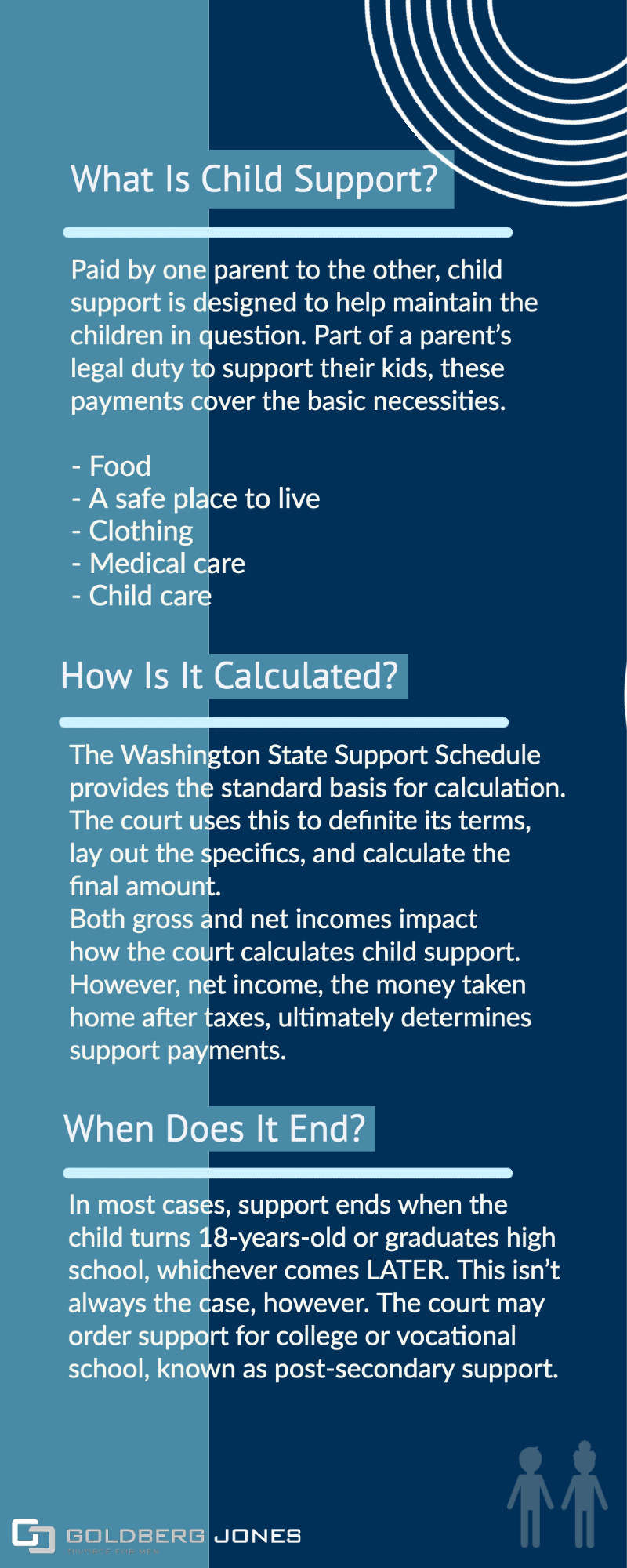
    child support infographic washingtonPaid by one parent to the other, child support is designed to help maintain and care for a child. Part of a parent’s legal duty to support their kids, these payments cover the necessities.

    Child support is often a continuing issue in divorce and child custody cases. Every situation is different, but there is a general formula for calculating the final amount.

    This includes providing:

    • Food.
    • A safe place to live.
    • Clothing.
    • Medical care.
    • Child care.
    • Other basic needs.

    A parent’s ability to pay also factors into the child support award. The court considers each party’s income and the children’s needs. This amount is called the basic support obligation, usually a monthly payment from the noncustodial parent to the custodial parent.

    Related Reading: What Is A Parenting Plan? What’s In It?

    How Is Child Support Calculated in Washington?

    The Washington State Support Schedule provides the standard basis for calculating child support. The court uses this formula to define its terms, lay out the specifics, and calculate the final amount.

    The child’s age plays a significant role. After age 12, the court may modify the amount to account for the added expense of raising a teenager.

    Both gross and net incomes impact how the court calculates child support. However, net income, the money taken home after taxes, ultimately determines support payments.

    Related Reading: Average Divorce Costs In Washington

    What Constitutes Income?

    The number the courts look at to calculate support payments is your after-taxes net income. This is also known as your take-home pay.

    In addition to wages, the court accounts for:

      • Tips.
      • Bonuses.
      • Unemployment and disability benefits.
      • Dividends.
      • Interest.
      • Commissions.
      • Public assistance.
      • Social Security/pensions.
      • Rental income.
      • Prize winnings.

    They also make allowances for:

      • Taxes.
      • Tax deductions.
      • Insurance.
      • Union dues.
      • Mandatory retirement contributions.
      • Funds owed to any other dependents.

    Will My New Spouse/Partner’s Income Impact Payments?

    While only your income and that of the custodial parent are included in the calculation, the court may account for your overall financial situation.

    This is exceedingly rare, but in specific circumstances, the court may consider a new spouse or live-in partner’s income.

    What If Payments Don’t Cover All the Expenses?

    The basic support obligation may not cover all of the child’s expenses. In some instances, the court may order the parents to share some costs.

    When it comes to uninsured medical expenses, insurance premiums, daycare, education, and long-distance transportation, parents often split payments.

    How Long Do Payments Last?

    In most cases, support obligations end when the child turns 18 or graduates from high school, whichever occurs later.

    In some circumstances, the court awards post-secondary support. This continues financial support after their 18th birthday or graduation, sharing the financial burden of college or other educational endeavors.

    Generally, you must file the petition for post-secondary support prior to the child turning 18 or graduating high school.

    In cases where a child can’t care for themselves mentally or physically, the court may also order continuing support. As with post-secondary support, you must also address this ahead of time.

    Related Reading: When Does Child Support Go Past 18?

    What If I Can’t Afford The Payments?

    There are situations where the court may set payments below the basic support obligation. These come with stiff penalties, however, if you don’t pay.

    You may qualify for a reduction if:

      • You fall below the federal poverty line.
      • The amount is more than 45% of your after-tax income.
      • You support other children.
      • If you split custody or have significant visitation.
      • You meet other qualifications.

    What if you need to modify your support order?

    In cases where a parent suffers financial hardship and can’t make support payments, the court may provide recourse to accommodate the circumstances.

    Most common of these is the loss of a job. This represents the most frequent reason for a change in economic situation.

    The court requires documentation that proves unemployment or a drastic change in income. Otherwise, they assume you will make payments as usual. You’re also expected to actively seek another source of income to meet the obligation.

    Even if you can show an extreme, long-term income drop, the court often still requires parents to continue making child support payments. Once in place, they’re reluctant to change these orders, so it’s best to ensure you’re comfortable with the payments before anything becomes final.

    Related Reading: Modifying a Child Support Order

    These are just a few of the many questions and issues surrounding child support and its calculation in Washington.

    As you see, it can be a complex endeavor that depends on many factors. In cases like these, you may be best served by hiring an attorney with experience in this field to guide you through. Whatever money you spend now may save you much more down the road.

    Related ReadingWhat Is The Division Of Child Support?

  • How Major Purchases Can Hurt Your Divorce

    If you’re going through a divorce, you may want to hold off making major purchases until the process is over. Here’s why.

    Divorce can be intricate and tricky. Especially regarding the division of property. Different states handle this part of the process in different manners.

    Can You Make Large Purchases During A Divorce?

    When it comes to breaking up assets, Washington, for example, follows a community property model. Resources, or debts, are split equitably between both parties.

    As this is the situation, you may want to delay making any big purchases until you finalize your divorce. Such spending often has a substantial impact on your divorce settlement.

    Community Property, Major Purchases, And Divorce

    Community property is a fairly straightforward concept. In this mode, the state considers all assets acquired during a marriage, even things held in one individual’s name, as the property of both spouses.

    In the case of divorce, this means that it can all be divided in an equitable fashion between both of you.

    This doesn’t mean an even split or that everything is doled out 50/50. Ideally, the division will be handled so each party comes out on a relatively even footing.

    Spouses work with each other, with mediators, or with the court, to agree on how to divvy up the shared assets in a fair and balanced way.

    Related Reading: Dividing Debt In Washington State

    If You Make A Purchase During Divorce

    Divorce comes with many expenses. This includes attorney’s fees, court costs, changes in tax status, and more. There are, however, other expenditures that also occur.

    If you make a big purchase while your divorce is pending, in some circumstances, under community property statutes, this may be included when it comes to the division of property.

    Various factors come into play in this ruling, like financing, where the funds to make the purchase originate, and what you buy.

    Depending on what you purchase, it may even look bad for you in the eyes of the court. For instance, if you’re fighting about things like child or spousal support and claim you can’t afford to make payments, buying expensive items raises questions.

    Can You Buy A Car During Divorce?

    Maybe you need a new car to shuttle the kids around. Or maybe a move results in a longer commute and you need a vehicle with better gas mileage.

    It’s one thing if you upgrade to a safer, more reliable car in which to transport your children or get to work. But If you run out and drop a bunch of money on an unnecessary car, however, you’ll have some explaining to do.

    Related Reading: No-Fault Divorce: What It Means For You

    If Your Spouse Makes A Purchase During Divorce

    Just as any big purchases you make may impact your divorce proceedings, those made by your spouse can have a similar effect.

    If your soon-to-be ex-wife claims she needs spousal support, but buys an unnecessary or impractical new car, or something of that ilk, it may reflect poorly on her.

    If you worry about your spouse spending communal money on big-ticket items from joint accounts, it may be possible to prevent this. In some cases, the court implements a temporary financial restraining order.

    While this measure still allows for the purchase of normal, regular necessities, when it comes to more substantial expenditures made from shared funds, it requires approval from both parties.

    Related Reading: Rebuilding Finances After Divorce

    The Impact Of Purchases Made During Divorce

    The fact that Washington is a community property state often impacts how the court views purchases made during the divorce. Where the money spent comes from also colors how they look at and classify purchases.

    If you or your spouse use shared funds to pay for an item, it will likely be looked at as a community asset and may be taken into account when the court rules on the distribution of property.

    What this usually means is that, if your spouse spends a significant sum on material goods, you will likely be given a larger portion of the remaining assets in order to offset the new acquisition.

    The opposite may be true if you are the one spending money in this fashion.

    While this is the case if a purchase is made with joint funds, if you use separate assets, the court may approach the item differently.

    For example, if your spouse uses premarital reserves, the court will most likely view this as an independent property.

    Along the same lines, after establishing a date of separation, the law considers each spouse’s income an individual resource. Any purchases made with that money will likely also be looked at as autonomous.

    In Washington, however, the court does have the power and authority to divide such separate property. This occurs when trying to achieve a more equitable end result.

    Related Reading: The Average Cost of Divorce in Washington

    Financing Purchases During Divorce

    Most major purchases are financed. While it looks like your spouse went on a reckless spending spree during your divorce, maybe they didn’t.

    Whether or not financed purchases factor into the division of property varies a great deal on a case-by-case basis.

    If a down payment came from joint funds, the court will likely consider this when splitting up assets. It may be viewed as pre-divorce property and treated as such.

    On the other hand, if that same down payment came from an individual source, that changes things. The court may opt to ignore this and award the item in question, and any future payments, to the purchaser.

    Related Reading: How to Protect a Business in Divorce

    Refinancing and Divorce

    It’s always worth noting that divorce does not change any loans or contracts you and your spouse entered into while married.

    If you bought a car or house, have regular payments, and both of your names are on the financial documents, the terms still apply equally to both of you. Just because you split up doesn’t automatically alter any preexisting deals.

    In the division of property, one party may be ordered to take care of a particular payment. Your name, however, remains on the record.

    In situations like this, if your spouse is awarded a house, car, or another high-value item you’re still paying off, your best bet is to have your ex refinance and remove your name. Any missed payments while your name remains on a loan impact you and your credit score. Even if the court orders your ex to make them.

    People often write the requirements into the final divorce agreement. Some divorce decrees specify that you or your spouse needs to rework a particular loan by a specific date.

    However, don’t take this for granted. Just because the court orders it, doesn’t mean your ex always makes payments or refinances loans. If they don’t, it can come back to bite you. This has a big impact on your finances, so make sure to keep an eye out.

    Related Reading: Who Pays for College After Divorce?

    Understand the Impact

    While it will likely be necessary to make some significant purchases during your divorce, understanding how they may influence the process is important.

    Remember, if you buy something during your divorce, in Washington, there is the possibility of losing it in the distribution of property.

    There are ways to ensure that such purchases cause as little havoc as possible. It’s simple, really. Stay away from impulse buys, think spending through in a calm, logical manner, and stick to necessities.

    If you absolutely must buy a big-ticket item with community funds during the divorce, talk to your attorney or work out a deal with your spouse.

    Related Reading: Rebuild Finances and Protecting Your Credit Score During Divorce

  • Keeping Custody Exchanges Civil

    Custody exchanges following divorce are often tough. No matter how bitter and hostile the process of ending your marriage was, if you have kids, you’re going to see your ex for at least a few minutes when picking up or dropping off.

    These tend to be difficult moments full of swirling emotions. All too often they erupt in conflict. It’s important to do what you can to minimize the fighting, for everyone’s sanity, but most importantly, for your kids.

    How To Deal With Tense Custody Exchanges

    Depending on how the parenting plan shakes out, you may potentially encounter your ex a few times a week. In the best of times, these custody exchanges are awkward. But there are things you can do to minimize the potential for friction.

    Here are some other ways to help smooth out custody exchanges.

    1. Make Exchanges in Public

    Many people are less likely to cause a scene if there are other folks around. You can use this to your advantage.

    Select a neutral spot where your ex is less likely to start a fight—though admittedly, some people will fight anywhere. A centrally located park or mall both offer good options. So do restaurants, coffee shops, and even supermarket parking lots.

    2. Bring A Witness

    Just like some people are reluctant to cause a stir in public, they may also behave better with a witness. Especially if it’s someone they know.

    Consider bringing a mutual acquaintance along for the custody exchange. A trusted friend who remains connected to both of you is often ideal.

    A third party may help smooth things out or just speed things along. And if the situation does turn dangerous, it never hurts to have someone there to see it all. Though let’s hope things aren’t that far gone.

    One caveat: If you have a new romantic interest in the picture, maybe don’t bring that person. This depends a great deal on just how much animosity there is, but a new significant other tagging along may cause more trouble than it’s worth.

    3. Preparation

    If you and your ex can’t be in the same room without fighting, don’t prolong the amount of time you have to spend together. Get everything together ahead of time. Preparing in advance makes things go faster and can smooth over potential rough spots.

    Whether for a quick overnight or a week-long vacation, make sure clothes, medications, school books, and anything else the kids need is ready to go. If they can’t live without it, pack it up.

    This also cuts down the chances of a late-night call or visit from your ex. And if you can send the kids right out the door, no one has to stand around waiting while you track down a lucky pair of pajamas.

    4. Custody Exchanges At Daycare

    Sometimes the best option is not to see your ex at all, and there are ways to accomplish this.

    One practical strategy many parents employ is to make custody exchanges at daycare or with a babysitter.

    Schedule things right and your ex drops the kids off and you pick them up. Or vice versa. Using child care as a kind of weigh station often cuts down on the fact time you have to endure with your ex.

    Communication and clear scheduling are key in these situations, but this approach often helps limit friction, contact, and conflict.

    5. Custody Exchanges At School

    Just like using daycare to trade off, you can use school to assist with custody exchanges.

    The concept is essentially the same as above: one parent drops the kids off in the morning, while the other picks them up in the afternoon.

    Executed properly, exchanges at school often limit face-to-face time with your former spouse.

    Again, like with child care, this takes communication. Not only do you and your ex have to be clear on the schedule, but this is the type of arrangement schools like to know. It’s less of an issue with teens and older kids, but administrators generally want to be aware of these plans.

    6. Alternate Forms Of Communication

    Visitation, overnight stays, and vacations are complicated enough. Add soccer practice, after-school robot club, and the myriad other activities kids participate in into the mix, and it turns into a logistical nightmare.

    No matter how much you’d rather not, if you have kids, you and your ex have to have at least some level of communication. Especially when your situation involves custody exchanges.

    Fortunately for many parents in this situation, modern technology presents alternate means of staying in touch. You can email, text, or use instant messenger. Online tools like Our Family Wizard and others offer scheduling services and co-parenting help.

    You can download apps on your smartphone. If you have friends or family members willing to help out and run messages back and forth, that’s also a possibility.

    After divorce, you may never want to see your ex again. If it’s just you, that’s fine. However, if you have kids, that’s not a realistic option. Custody exchanges are likely to be a fact of life. But there are ways to cut down on conflict and friction in these situations.

    Related ReadingWhat Does a Parenting Plan Include?

    Safe Exchange Zones

    In less-than-optimal circumstances, custody exchanges can devolve into open conflict. If things are bad, these meetings may even turn dangerous.

    More and more cities have started providing “Safe Exchange Zones.” Essentially, the police designate an area, be it parking spots or the lobby of a police station for strangers to meet up and exchange money or goods from websites like Craiglist. This can also be used for custody exchanges.

    Related Reading: Seattle Police Department Offers Safe Havens in Precinct Lobbies

    In Osage Beach, Missouri, they established a “Safe Exchange Zone” specifically for child custody exchanges.  Essentially, the police designated two parking spots in front of City Hall for parents to meet up.

    The area is under 24-hour surveillance seven days a week. Though they still recommend using good judgment, like meeting during daylight hours, they intend to provide a safe space for custody exchanges.

    Under the watchful eye of law enforcement, parents are less likely to cause a scene or do anything illegal. This is one way to keep things civil and ensure everyone plays nice.

    Hopefully, your situation doesn’t require police supervision, but there’s often still some level of friction.

    It may be a hard and a huge hassle, but it’s worth it for the sake of the kids. And to be honest, it’s also beneficial for your peace of mind and well-being.

    Have a plan in advance, be as efficient as possible, and make sure to communicate as clearly as you can. Do it right and it’ll all be over in a few minutes and everyone can keep their emotions in check. It’s better for everyone that way.

    Related ReadingGuardian Ad Litem: What You Need to Know

  • How Do You Get Divorced If You Can’t Find Your Spouse?

    Divorce gets complicated and stressful in relatively short order. There’s a lot to consider. Collaborative divorce, mediation, a do-it-yourself approach. These elements all add unexpected wrinkles. But what if you can’t find your spouse?

    Can you still divorce if you don’t know where your spouse lives? How do you end a marriage if you can’t find your soon-to-be-ex?

    Luckily, you do have options.

    Fortunately, Washington is a no-fault divorce state. This means the government can’t and won’t force you to remain married. It requires a few additional steps, but it is possible.

    Can You Get A Divorce If You Don’t Kow Where Your Spouse Is?

    Yes, though this makes things trickier. Fortunately, you can proceed with a divorce if your spouse is MIA.

    In Washington, you need to initiate a case with the courts. This is the first step no matter the situation.  It’s the next step where things become more complex.

    Once you file the initial divorce paperwork, you must serve the other party. It’s easy to see how you might have trouble with this if you can’t find your spouse.

    Still, you must try.

    You need to do your due diligence in attempting to locate your spouse. Put in the leg work and make an earnest, good-faith effort. Once you exhaust all possible avenues, then the case can move on.

    It’s important here to document your efforts. You need to prove to the court that you tried.

    Collect evidence that you put in the time and effort. If you hire a private investigator, keep records. Check their last known residence and last known employers. If you request DMV records, save them. Keep track of all your moves.

    Related Reading: How Do I File For Divorce In Washington?

    Motion to Serve by Publication

    After exhausting all possible ways to find your spouse, and documenting your quest, then the time comes to move forward.

    If you can’t locate the other party, you file a “motion to serve by publication.”

    Before you submit this, however, the court must approve this measure. Hence, why you need to show that there are no other options.

    Once the court gives you the go-ahead, you then place a public notice of your intention in an acceptable outlet.

    This usually means a local newspaper or one where your spouse was last known to live. Most publications like this have a section dedicated to legal notices of this sort.

    Once you publish this notice, if you still receive no response after the allotted time, you move on by filing a “motion for default.”

    Related Reading: Jurisdiction: Where You File For Divorce Matters

    Motion For Default

    When you can’t find your spouse, filing a motion for default is the next step.

    After you’ve shown that your spouse is nowhere to be found, and that you put in the effort to find them, this asks the court to grant you your divorce.

    If the court approves this measure, it essentially means they grant all your requests. You generally receive everything you asked for in the original divorce petition because no one showed up to oppose it.

    Even though this sounds fairly straightforward, you still may want to consult a divorce attorney. They’ll guide you through the process and make sure you check off all the right boxes.

    You don’t want to put in a ton of effort only to have a judge deny your motions.

    Or worse, you don’t want to do a half-hearted search and have your spouse show up at the last minute to derail your plans.

    Like most things in divorce, if you’re going to do it, do it right the first time. The effects of ending a marriage last for years, if not longer. This isn’t the time for haphazard shortcuts.

    Related Reading: My Ex Won’t Follow The Divorce Agreement