Category: Child Support

  • What Is The Washington Division Of Child Support?

    So you went through a divorce and custody hearing. It was long, it was tough, but you got primary guardianship and the court awarded you regular child support.

    Getting these payments awarded is one thing, but all too often, compelling your ex to pay them is another. One key tool for enforcing these orders is the Washington Division of Child Support.

    What Is ‘The Washington Division Of Child Support’?

    A part of the Economic Services Administration, itself a part of the Department of Social and Health Services, the Washington Division of Child Support has a simple goal. That aim is to aid parents in collecting and paying court-ordered child support. They hope to “help parents contribute to brighter futures for their children” by facilitating these payments.

    Related Reading: How Are Child Support Payments Calculated In Washington State?

    How Does It Work?

    In seeking to ensure the best for young people, the Washington Division of Child Support provides a wide variety of services and resources.

    Their goal is to help custodial parents collect child support and help non-custodial parents pay.

    Along the way, they assist in various ways to facilitate that. These efforts run the gamut and include legal advice, housing services, support in situations of domestic violence, and even employment training.

    On their website, you can find links to pay or receive child support on DCS cases. You can download a number of forms with topics ranging from enforcing child support to declaring unlawful custody to requesting a modification of an existing order.

    There are also forms to declare your income and expenses, ones requesting similar information from the other party, and a ton of additional material.

    Related ReadingCan I Modify My Support Payments?

    For Parents

    Making child support payments often proves a financial burden for many parents. And on the other side, collecting from an ex who can’t or won’t pay is also a problem. At best, it’s a headache and a nuisance.

    The Division of Child Support seeks to remove any barriers, with an endgame of helping families become self-sufficient in the long run.

    The Washington DCS maintains a list of useful resources for parents on both sides of these conflicts. Their web page features links to numerous state agencies, including services like childcare providers for working parents, education resources, and instruction to improve future employment and earning potential.

    In addition to state agencies, the DCS also lists information for many community organizations.

    There are resources available for both mothers and fathers, information about child welfare, and contacts for regional housing authorities. Other links of interest include legal support and information to help with custody, visitation, and just about any type of legal matter.

    For Employers

    Parents obviously play the largest role when it comes to financially supporting children, but employers also have an important part.

    Washington employers collaborate with the Division of Child Support in a number of ways, helping make sure employees with maintenance obligations actually pay what they owe.

    The law requires all Washington employers to report new hires to DSHS within 20 days of their date of hire. This helps keep track of parents and their ability to pay outstanding child support. Additionally, employers can also withhold income, send delinquent payments directly to the DCS, and help enroll kids in health insurance. 

    Child support orders are complicated and intricate documents. Many factors go into determining the maintenance amount, including need, ability to pay, and more. They’re hugely important for the stability, safety, and future of children. As a result, the Washington Division of Child Support plays an important role.

    Related Reading: Can My Ex Keep My Child From Playing Sports?
  • How Is Child Support Calculated in Washington?

    Going through a separation, divorce, or custody dispute can be stressful. Determining how child support is calculated in Washington only adds to that strain.

    Parenting plans and support arrangements are complex areas of law, and a plethora of issues often arise in their resolution. One facet of child custody that raises many questions is: How does Washington calculate child support?

    Before tackling what factors impact support payments, we first need to understand what the term means.

    What Is Child Support?

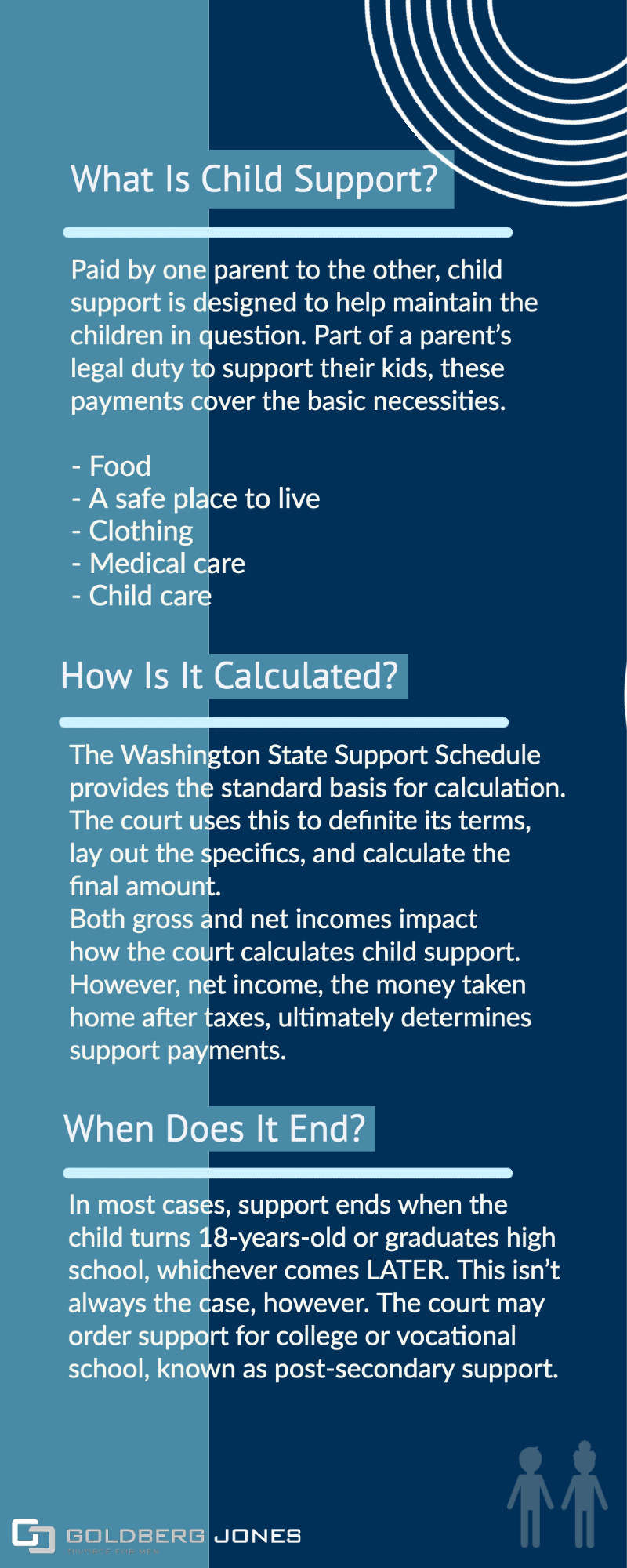
    child support infographic washingtonPaid by one parent to the other, child support is designed to help maintain and care for a child. Part of a parent’s legal duty to support their kids, these payments cover the necessities.

    Child support is often a continuing issue in divorce and child custody cases. Every situation is different, but there is a general formula for calculating the final amount.

    This includes providing:

    • Food.
    • A safe place to live.
    • Clothing.
    • Medical care.
    • Child care.
    • Other basic needs.

    A parent’s ability to pay also factors into the child support award. The court considers each party’s income and the children’s needs. This amount is called the basic support obligation, usually a monthly payment from the noncustodial parent to the custodial parent.

    Related Reading: What Is A Parenting Plan? What’s In It?

    How Is Child Support Calculated in Washington?

    The Washington State Support Schedule provides the standard basis for calculating child support. The court uses this formula to define its terms, lay out the specifics, and calculate the final amount.

    The child’s age plays a significant role. After age 12, the court may modify the amount to account for the added expense of raising a teenager.

    Both gross and net incomes impact how the court calculates child support. However, net income, the money taken home after taxes, ultimately determines support payments.

    Related Reading: Average Divorce Costs In Washington

    What Constitutes Income?

    The number the courts look at to calculate support payments is your after-taxes net income. This is also known as your take-home pay.

    In addition to wages, the court accounts for:

      • Tips.
      • Bonuses.
      • Unemployment and disability benefits.
      • Dividends.
      • Interest.
      • Commissions.
      • Public assistance.
      • Social Security/pensions.
      • Rental income.
      • Prize winnings.

    They also make allowances for:

      • Taxes.
      • Tax deductions.
      • Insurance.
      • Union dues.
      • Mandatory retirement contributions.
      • Funds owed to any other dependents.

    Will My New Spouse/Partner’s Income Impact Payments?

    While only your income and that of the custodial parent are included in the calculation, the court may account for your overall financial situation.

    This is exceedingly rare, but in specific circumstances, the court may consider a new spouse or live-in partner’s income.

    What If Payments Don’t Cover All the Expenses?

    The basic support obligation may not cover all of the child’s expenses. In some instances, the court may order the parents to share some costs.

    When it comes to uninsured medical expenses, insurance premiums, daycare, education, and long-distance transportation, parents often split payments.

    How Long Do Payments Last?

    In most cases, support obligations end when the child turns 18 or graduates from high school, whichever occurs later.

    In some circumstances, the court awards post-secondary support. This continues financial support after their 18th birthday or graduation, sharing the financial burden of college or other educational endeavors.

    Generally, you must file the petition for post-secondary support prior to the child turning 18 or graduating high school.

    In cases where a child can’t care for themselves mentally or physically, the court may also order continuing support. As with post-secondary support, you must also address this ahead of time.

    Related Reading: When Does Child Support Go Past 18?

    What If I Can’t Afford The Payments?

    There are situations where the court may set payments below the basic support obligation. These come with stiff penalties, however, if you don’t pay.

    You may qualify for a reduction if:

      • You fall below the federal poverty line.
      • The amount is more than 45% of your after-tax income.
      • You support other children.
      • If you split custody or have significant visitation.
      • You meet other qualifications.

    What if you need to modify your support order?

    In cases where a parent suffers financial hardship and can’t make support payments, the court may provide recourse to accommodate the circumstances.

    Most common of these is the loss of a job. This represents the most frequent reason for a change in economic situation.

    The court requires documentation that proves unemployment or a drastic change in income. Otherwise, they assume you will make payments as usual. You’re also expected to actively seek another source of income to meet the obligation.

    Even if you can show an extreme, long-term income drop, the court often still requires parents to continue making child support payments. Once in place, they’re reluctant to change these orders, so it’s best to ensure you’re comfortable with the payments before anything becomes final.

    Related Reading: Modifying a Child Support Order

    These are just a few of the many questions and issues surrounding child support and its calculation in Washington.

    As you see, it can be a complex endeavor that depends on many factors. In cases like these, you may be best served by hiring an attorney with experience in this field to guide you through. Whatever money you spend now may save you much more down the road.

    Related ReadingWhat Is The Division Of Child Support?

  • Verifying Post-Secondary Support Payments

    In most cases following divorce, child support payments end when a child turns 18, or when they graduate high school, whichever comes later. There are scenarios where it continues, and post-secondary education is probably the most common. In this situation, payments continue beyond the child’s 18th birthday.

    These payments are expensive—it’s no surprise college is pricey. You may be on the hook for your child’s tuition. It makes sense to want to verify these post-secondary support payments, but how?

    One of our founding partners, Rick Jones, regularly appears on the Danny Bonaduce and Sarah Morning Show, to answer common family law questions. On a recent episode, a listener emailed in a question about this very topic.

    His daughter recently graduated from community college. She says she plans to enroll in the University of Washington but hasn’t given him any proof. He wants to continue to support her, but at the same time, he doesn’t want to be taken advantage of.

    How can he go about verifying his post-secondary support payments?

    Related Reading: When Can Child Support Continue Past Age 18?

    Check out the Post-Secondary Support Conversation Below:

    Question: “Tom’s daughter recently graduated from a community college. The court orders say he has to pay [post-secondary support] until she graduates or [until] her 23rd birthday. Supposedly she’s trying to go to the UW now, but she’s not supplied him any kind of paperwork or proof. Just a Facebook picture of her at Husky Stadium. [Background laughter.] What kind of proof do they need to supply that she’s actually enrolled in the university?”

    Danny:I have pictures of me at Husky Stadium.”

    Sarah: “Does she have to provide proof or because she graduated from community college, is that her graduating and he’s done [paying child support]?

    Rick: “Well first, Go Dawgs!

    “You know, it’s actually a really good question. The fact that she graduated from a community college doesn’t necessarily put an end to it because we know that there can be more, especially for an aspiring student. Certainly, the court’s attitude is very open to continuing education, so I don’t see the door shutting on that.

    “At the same time though, she is going to need to prove that it’s more than just a spoof on him. Whether it’s registration, whether it’s a grade report or at least progress to it.

    “If she misses a quarter or misses a summer, it’s not going to be the death-nail for it. But let’s say she misses a couple of quarters or doesn’t enroll for a couple of quarters, then that is problematic for her.”

    Sarah: “And does he just stop paying then, or does he have to go back to the court and say, ‘She’s not proven that she’s going to school, can I stop paying?’”

    Rick: “It depends on how he’s paying right now. Most orders go through the state, through this DCS [Division of Child Support] I was talking about. So if he’s already doing that, he really should be continuing that or at least getting with them and explain why he’s going to be stopping.

    “If he’s paying the institution directly, well, obviously that stopped because it’s no longer community college.

    “If he’s paying the mother—which would be rare for post-secondary—but if he’s paying the mother, then yeah, stop.

    Related Reading: Child Support Modification: How To Change A Child Support Order