Category: Featured Posts

  • How Is Child Support Calculated in Washington?

    Going through a separation, divorce, or custody dispute can be stressful. Determining how child support is calculated in Washington only adds to that strain.

    Parenting plans and support arrangements are complex areas of law, and a plethora of issues often arise in their resolution. One facet of child custody that raises many questions is: How does Washington calculate child support?

    Before tackling what factors impact support payments, we first need to understand what the term means.

    What Is Child Support?
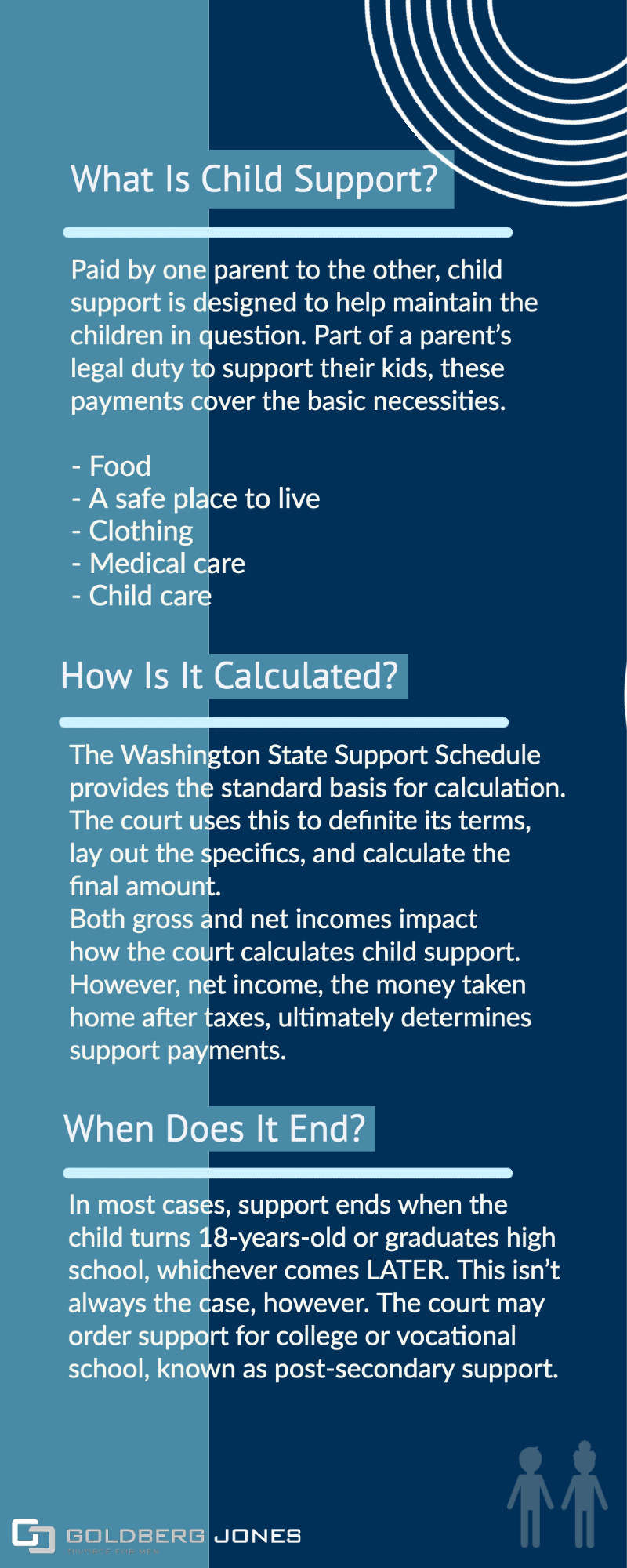
    child support infographic washingtonPaid by one parent to the other, child support is designed to help maintain and care for a child. Part of a parent’s legal duty to support their kids, these payments cover the necessities.

    Child support is often a continuing issue in divorce and child custody cases. Every situation is different, but there is a general formula for calculating the final amount.

    This includes providing:

    • Food.
    • A safe place to live.
    • Clothing.
    • Medical care.
    • Child care.
    • Other basic needs.

    A parent’s ability to pay also factors into the child support award. The court considers each party’s income and the children’s needs. This amount is called the basic support obligation, usually a monthly payment from the noncustodial parent to the custodial parent.

    Related Reading: What Is A Parenting Plan? What’s In It?

    How Is Child Support Calculated in Washington?

    The Washington State Support Schedule provides the standard basis for calculating child support. The court uses this formula to define its terms, lay out the specifics, and calculate the final amount.

    The child’s age plays a significant role. After age 12, the court may modify the amount to account for the added expense of raising a teenager.

    Both gross and net incomes impact how the court calculates child support. However, net income, the money taken home after taxes, ultimately determines support payments.

    Related Reading: Average Divorce Costs In Washington

    What Constitutes Income?

    The number the courts look at to calculate support payments is your after-taxes net income. This is also known as your take-home pay.

    In addition to wages, the court accounts for:

      • Tips.
      • Bonuses.
      • Unemployment and disability benefits.
      • Dividends.
      • Interest.
      • Commissions.
      • Public assistance.
      • Social Security/pensions.
      • Rental income.
      • Prize winnings.

    They also make allowances for:

      • Taxes.
      • Tax deductions.
      • Insurance.
      • Union dues.
      • Mandatory retirement contributions.
      • Funds owed to any other dependents.

    Will My New Spouse/Partner’s Income Impact Payments?

    While only your income and that of the custodial parent are included in the calculation, the court may account for your overall financial situation.

    This is exceedingly rare, but in specific circumstances, the court may consider a new spouse or live-in partner’s income.

    What If Payments Don’t Cover All the Expenses?

    The basic support obligation may not cover all of the child’s expenses. In some instances, the court may order the parents to share some costs.

    When it comes to uninsured medical expenses, insurance premiums, daycare, education, and long-distance transportation, parents often split payments.

    How Long Do Payments Last?

    In most cases, support obligations end when the child turns 18 or graduates from high school, whichever occurs later.

    In some circumstances, the court awards post-secondary support. This continues financial support after their 18th birthday or graduation, sharing the financial burden of college or other educational endeavors.

    Generally, you must file the petition for post-secondary support prior to the child turning 18 or graduating high school.

    In cases where a child can’t care for themselves mentally or physically, the court may also order continuing support. As with post-secondary support, you must also address this ahead of time.

    Related Reading: When Does Child Support Go Past 18?

    What If I Can’t Afford The Payments?

    There are situations where the court may set payments below the basic support obligation. These come with stiff penalties, however, if you don’t pay.

    You may qualify for a reduction if:

      • You fall below the federal poverty line.
      • The amount is more than 45% of your after-tax income.
      • You support other children.
      • If you split custody or have significant visitation.
      • You meet other qualifications.

    What if you need to modify your support order?

    In cases where a parent suffers financial hardship and can’t make support payments, the court may provide recourse to accommodate the circumstances.

    Most common of these is the loss of a job. This represents the most frequent reason for a change in economic situation.

    The court requires documentation that proves unemployment or a drastic change in income. Otherwise, they assume you will make payments as usual. You’re also expected to actively seek another source of income to meet the obligation.

    Even if you can show an extreme, long-term income drop, the court often still requires parents to continue making child support payments. Once in place, they’re reluctant to change these orders, so it’s best to ensure you’re comfortable with the payments before anything becomes final.

    Related Reading: Modifying a Child Support Order

    These are just a few of the many questions and issues surrounding child support and its calculation in Washington.

    As you see, it can be a complex endeavor that depends on many factors. In cases like these, you may be best served by hiring an attorney with experience in this field to guide you through. Whatever money you spend now may save you much more down the road.

    Related ReadingWhat Is The Division Of Child Support?

  • Ways To Protect Custody and Visitation

    One of the most harrowing parts of many divorces is the fight for child custody and visitation. The prospect of not being a part of their children’s lives, or at least having a diminished presence, terrifies many parents. Every situation is different, but in general, there are some dos and don’ts you can use to protect your custody and visitation rights as a parent.

    How Can You Protect Your Custody and Visitation Rights?

    It’s essential to put your best foot forward and portray yourself as a responsible, ideal parent. With that in mind, here are some dos and don’ts to help protect child custody and visitation.

    Do: Work With Your Ex

    Unless there are extreme circumstances in play, as long as both parents are in the picture, there will be some level of contact. Raising a child takes collaboration.

    If you continually show you’re unwilling to do this, it damages your cause. So, put aside your feelings and do what’s best for the kids.

    Even if you don’t particularly like each other, you and your ex have to work together.

    Related Reading: What to Expect from Custody Hearings

    Don’t: Move Out

    When ending a marriage, moving out seems like the natural choice. However, leaving a shared home often hinders your case later when it comes to custody and visitation.

    It’s all about perception with the courts, and it can look like you left children behind or that you’re not a dedicated parent.

    That may not be the case, but in the eyes of the court, it often reflects poorly. And if we’re talking about a heated battle, your ex may trot that out as an example of why you’re not a fit parent.

    Related Reading: Moving Out: What You Need To Know

    Do: Stay A Part Of Your Children’s Daily Life

    Being involved in your child’s daily life is important for many reasons. It helps your relationship, it’s good for both of you, and it may further your cause when it comes to custody and visitation.

    Spending regular quality time with the kids demonstrates in a concrete way the desire to be an involved parent.

    Also, when ruling on custody and the like, the court often tries to minimize drastic changes in schedule and routine. If you’re already an active participant, that’s less likely to change.

    Related Reading: Can I Still Smoke Weed? Legal Marijuana and Child Custody

    Don’t: Allow Your Ex To Remove You From Your Child’s Life

    Remaining a part of your child’s daily life isn’t always as simple as it sounds. This is especially true if your ex actively tries to cut you out of the picture or limit your visitation.

    It’s important to you, your case, and your relationship with your kids to stand up and not let your ex push you around.

    An occasional change of schedule is one thing, but if it becomes a pattern, you should consult your attorney to learn what to do and formulate a plan of action.

    Do: Know Your Rights

    It’s helpful to have an experienced attorney in your corner. But there’s also a lot of other information out there. Read up on custody laws where you live, find out how the courts determine visitation and parenting time, and learn how the state calculates child support.

    The more information you have, the better prepared you’ll be. This often goes a long way toward informing the strategy of your case.

    Don’t: Wait to Act

    It’s vital to take an active approach when it comes to child custody and visitation. A wait-and-see strategy often puts you at a disadvantage.

    Instead of acting, parents too often find themselves reacting to the other party’s actions. Instead of pushing for what you want and need, you spend time and energy going back against your ex.

    Related Reading: What’s in a Parenting Plan?

    Do: Document Everything

    Make sure to document and keep track of everything. Did your ex send an email unjustly denying you a scheduled visit? Save it. The same goes for text messages, social media posts, and voicemails.

    If you legitimately believe your child isn’t safe with your ex, keep records of why. You’ll need to show your work.

    Maintain a chronicle of the time you spend with your kids. That way, if your ex says you’re not involved, you have indisputable proof.

    Whatever claims you make to a judge, collect as much concrete evidence as you can to back up your statements.

    Don’t: Interfere With Your Ex’s Visitation

    You probably have all manner of ill feelings towards your ex. There are bound to be bruised emotions in divorce. But it’s still important for both parents to remain in a child’s life, so long as it’s not dangerous.

    If there’s visitation scheduled, don’t interfere or try to block it. If nothing else, it makes you look petty.

    And if you complain that your ex hampers your visitation, think about how it looks to a judge if you turn around and do the same thing.

    Do: Make Use of Your Parental Rights

    This goes back to remaining a part of your child’s life, but if you have parental rights, exercise them. If a temporary custody order gives you regular visitation, take advantage of that. Spend as much time with your kids as possible.

    This includes significant, special events, but also everyday things like homework or watching a movie. One, it’s beneficial to the kids and the parent-child bond. Two, it strengthens your case as an involved, concerned, dedicated parent. Simply being there often goes a long way.

    Don’t: Arrive Late, Reschedule, or Cancel

    Schedules change, last-minute complications arise, and sometimes things just don’t work out. That happens. But as much as possible, if you have a visit scheduled, don’t show up late, reschedule, or cancel.

    Not only is this frustrating for your children—it’s hard to get expectations up and have them not met—but it also leaves a negative impression. Consistently missing visits paints a picture of a parent who puts other things ahead of the children and their needs.

    Do: Abide By Temporary Court Rulings

    While the court deliberates over awarding child custody and visitation, the judge will likely dole out temporary orders. These can include:

    • Interim custody.
    • A visitation schedule.
    • Dividing holidays.
    • Child support.

    Stick to these. If you don’t, you can wind up facing contempt charges. At the very least, this makes you look unwilling to cooperate or that you don’t have the children’s best interests in mind.

    Related Reading: Violating Divorce Agreements: When To File A Motion For Contempt

    Don’t: Trash Talk Your Ex To The Kids

    Again, you may hate your ex. But while you’re with the kids, keep those feelings under wraps. Don’t use them as pawns in custody battles or try to turn them against your ex.

    Not only is it unhealthy for them, but if it appears you’re trying to manipulate them or turn them against your ex, it reflects negatively on your case.

    Instead of trying to make your ex look bad, focus on making yourself look good. Be the absolute best parent you can be. That helps your case so much more than going negative. It’s also much better for your kids.

    Do: Hire An Attorney Experienced in Child Custody and Visitation

    These cases are often complicated and messy. Flaring tempers and heated emotions only amplify this. It’s most likely in your best interest to hire an experienced child custody attorney.

    This is especially true if your ex enlists the help of a lawyer. Not only can a litigator guide you through the process, but when things get hot and you may not act rationally, an attorney can help calm things down and advise you on the best way to proceed.

    Other Reading: Establishing Paternity in Washington

  • Divorce Jurisdiction: Where You File Matters

    So many factors impact your divorce. A huge one is when you decide to file for divorce. Because, as you’ll learn, jurisdiction has a major impact on your case.

    How Does the Jurisdiction You Choose Affect Divorce And Child Custody?

    If you and your spouse have established residency in a single state, you only really have one option about where to file for divorce.

    But if you’ve recently moved, if the two of you live in different states, or even if you own homes elsewhere, all of that influences which state has jurisdiction over your case. Or at least it can.

    Different states often have very, very different rules for divorce and custody. In some states, laws even vary by county.

    For example, in property division, Oregon follows an equitable distribution model. Washington, on the other hand, is a community property state. This means the two states view and thus divide assets in specific ways.

    And that’s just one area where jurisdiction comes into play.

    States often differ on custody, the child support formula, spousal support, and more. It may not always have a drastic influence, but you may find one state’s laws favor your case where another’s don’t.

    However it works out, it’s an important topic to consider.

    Related Reading: How Does Washington Divide Debt In Divorce?

    Where You File For Divorce

    People often think you have to file for divorce in the state where you married. That’s not true.

    You do, however, need to be a legal resident of the state where you file.

    Some states require a waiting period after you become a resident before you can file. This keeps people from moving to a new state with favorable laws and divorcing right away, thus gaming the system.

    Washington doesn’t work this way, but it does have certain stipulations.

    You must be a Washington resident, a member of the armed forces stationed here, or married to a Washington resident or member of the military stationed here. If you check one of those boxes, you can file for divorce here.

    When spouses live in different states, this also impacts jurisdiction.

    For example, if your spouse lives in California, she can file there. If you both agree, you can file wherever you please.

    In most cases, the state where the papers are ultimately filed maintains jurisdiction. This presents something to consider when filing. Timing may also be a factor.

    Related Reading: Preparing for a Consultation With a Divorce Lawyer

    Jurisdiction And Divorce

    So, how exactly does jurisdiction impact divorce? It can play into how financial matters shake out. Often, it influences how much time you spend with your children. In reality, it can and often does sway almost every aspect of the process.

    • Division of Property: As mentioned earlier, Washington follows community property principles when dividing assets during a divorce. This is different from Oregon, which uses the equitable distribution model. Community property views all assets acquired during a marriage as equally belonging to both spouses. This has a significant influence on how courts allocate assets and debts. It’s essential to understand how things vary from one jurisdiction to another.
    • Child Custody: Many factors influence custody decisions, and states weigh them all differently. The language often varies from state to state. Some states even allow non-blood relatives to vie for custody in certain cases. Deciding jurisdiction in custody cases is a complex issue, but more on that later.
    • Child Support: Child support payments cover a child’s basic necessities. Things like food, shelter, medical care, and education. States generally follow a rigid formula to determine this number. It weighs various factors. You plug certain numbers into an equation, and it produces an amount. But like other areas, variations to the formula occur as you cross state borders, which can cause major changes.
    • Spousal Support: Spousal support doesn’t follow a strict formula like child support, but the goal remains similar. It aims to provide financial support for dependent spouses after divorce. In some cases, it only lasts a short time. In others, it continues indefinitely. As you probably guessed, how states approach this varies greatly. Oregon, for example, has three specific types of spousal support. Washington, on the other hand, doesn’t, though payments tend to follow a pattern based on factors such as the length of the marriage, earning potential, and financial need.

    How Children Impact Jurisdiction

    Children tend to complicate divorce proceedings. Their presence affects things emotionally and financially, and they can even play a role in determining jurisdiction.

    We mentioned above how jurisdiction affects custody, but children can also influence where a case takes place.

    Spouses can agree to which state has jurisdiction. But when a divorce involves a custody component, that decision isn’t always entirely up to the parents.

    Things can get very complicated, which is where the Uniform Child Custody Jurisdiction and Enforcement Act comes in.

    Created in the 1960s and adopted by every state by the early 1980s, the UCCJEA establishes rules governing jurisdiction in child custody cases. A complex set of rules and regulations, it establishes the “home state” in these situations.

    Under the UCCJEA, courts consider many factors. Where the child has lived for the past six months is a major factor. If a child has significant connections in a state, that also plays a role. In grave circumstances, states can even declare emergency jurisdiction.

    The goal is to serve the best interests of the child or children in question. This is already a traumatic time, and the laws aim to best help the children’s well-being. So, though you may want to file for divorce in one state, in certain situations, another state may hold jurisdiction.

    These are only a few of the ways in which you file for divorce matters. Jurisdiction can have a major influence on many aspects of ending a marriage. Laws often vary in ways you don’t expect. As such, it’s vital to know the specific rules and regulations that apply to your case.

    If you have questions about your divorce, contact Goldberg Jones at our Seattle office. Our experienced attorneys are well-versed in Washington divorce and custody law.

    Related Reading: What to Expect From Child Custody Hearings

  • How Does Legal Marijuana Affect Child Custody?

    Here’s a popular question we hear all the time: How does legal marijuana affect child custody?

    When Washington State voted to legalize the recreational use of marijuana in 2012, it opened up a metaphorical can of worms. Legally speaking. Initiative 502, which passed by a 56% to 44% margin in a general election, allows adults over the age of 21 to possess and use small amounts of the drug for fun and games.

    It does, however, remain illegal on the federal level and is heavily regulated. This includes who can buy it, where it can be purchased, and when and where it can be used.

    This decision had a big impact on taxes, laws, and even criminal proceedings. Prosecutors quickly dropped most pending misdemeanor cases.

    Despite this newfound legal status, and the fact that you can buy it at one of the many stores that dot the Washington landscape like springtime mushrooms, recreational marijuana use still carries a stigma. Additionally, it often affects child custody cases.

    Since legal weed is a fairly new phenomenon, there’s not a lot of hard data about how it impacts child custody decisions. We do, however, hear anecdotal stories from all over the place, not just Washington.

    • People have lost temporary custody of their children after obtaining a medical marijuana card.
    • A couple growing legal plants had their child taken away by the authorities, and there are more tales like this floating around.

    Many of these cases eventually went the way of the parents, with the courts deciding that the children were not in any actual immediate danger. This does, however, illustrate a larger issue: legal marijuana use is a huge gray area when it comes to child custody and well-being.

    How Legal Marijuana Use Impacts Custody:

    From a theoretical standpoint, legal marijuana use falls into a similar category as alcohol consumption. The reality, however, is that they’re not always treated the same way. As there aren’t any set-in-stone guidelines, cases are likely to vary a great deal depending on the people involved.

    Though Washington and an increasing number of other states now consider marijuana legal, under federal law it still falls in the same category as heroin, LSD, and other Schedule 1 drugs. While this shouldn’t directly impact your custody case, it speaks to the stigma attached to the substance.

    When many people think of marijuana smokers, rightly or wrongly, they often picture a burned-out dude sitting on a couch, surrounded by a haze of smoke, plowing through a giant tub of cheese puffs.

    Child custody cases can be tense and hostile to begin with. If the issue is hotly contested between you and your ex, it’s possible there will be mud-slinging involved.

    If you regularly use marijuana, this fact may be brought up as an illustration of why you’re an unfit parent. Whether that’s true or not.

    The court likely won’t base a decision in your custody case solely on whether or not you use recreational marijuana. But it could very well be a factor. Occasional use is one thing, but if evidence shows it significantly impairs your ability to take care of your children or endangers their health and welfare, expect an impact.

    How To Protect Yourself:

    Marijuana use won’t likely preclude you from winning custody in a divorce, though it may play a part. And there are steps you can take to lessen the impact and protect your custodial rights.

    Perhaps the biggest rule of thumb is, don’t be reckless.

    • If you have paraphernalia, don’t leave it lying around where the kids have access to it.
    • Regardless of the regularity of your use, take steps to limit your kid’s exposure to any controlled substances.
    • If edibles, like brownies or cookies, are more your speed, keep them secure. Stash them out of the way in a place where your children aren’t going to happen across them when looking for a snack.

    In short, use common sense and don’t create an unsafe environment, or even one that can be construed as such.

    Again, going back to the alcohol parallels is a good place to look for guidance. If your marijuana use negatively impacts your capacity to look after your children, leave the bong on the shelf for the night.

    Perhaps talking to your kids about it will help. It should also go without saying, but if you’re going to be behind the wheel of a car, especially when your children are involved, don’t be impaired in any way. For everyone’s safety.

    Much like with cigarettes, smoking marijuana around your kids is also likely going to be frowned upon by authorities. Consider the people deciding who gets guardianship and determining the extent of your visitation.

    When It Becomes a Problem

    Substance abuse, regardless of the legal standing of the intoxicant in question, is almost always going to come into play when the court establishes custody in a divorce.

    Marijuana is no different in that regard. It may be legal in Washington, and you may be able to buy it at the new pot shop that just opened down the street, but you still need to be aware of the ramifications. And like alcohol, if you overindulge or marijuana use becomes an issue in your life, it can become an issue in your custody case as well.

    The final decision will likely vary case-by-case and court-to-court. Regardless, refrain from giving your ex any additional ammunition when it comes to custody.

    If you have questions about how marijuana use impacts your situation, your best bet may be to consult an attorney. Or if you think it could play a part, maybe take a break from Mary Jane until there is a resolution.

    What About Vaping?

    More and more, instead of smoking marijuana, people choose to vape. This option has ballooned in popularity. As opposed to burning the marijuana and inhaling the smoke, a device heats the cannabis until it releases the active ingredients, which are then inhaled.

    There’s a debate about the relative safety of vaping as opposed to smoking, but for our purposes, let’s focus more on how it impacts child custody.

    As this is relatively new, there’s not much hard data on the matter. Certainly since vaping produces no smoke, that means there are none of the risks associated with second-hand smoke. That’s likely considered a positive by some.

    That said, courts may also view this as similar to smoking cigarettes around your children in terms of safety. Others may not. Still more will view using marijuana around your kids in any capacity as a negative.

    There’s so much uncharted territory, and it varies from one case to the next, it’s next to impossible to predict how a specific judge will react. 

    In general, the courts will likely view marijuana consumption as marijuana consumption, no matter the delivery method. This is true whether you smoke, vape, or use edibles or other products. If it’s part of your life, it’s likely to become a topic of discussion in your custody case.

    Do what you can to limit the effect it has. If you worry it will become a point of contention, take steps to make sure that doesn’t happen. If that means taking a break, take a break.

    Related Reading: Does It Matter Who Files For Divorce First?

    Has the Stigma Around Legal Marijuana Changed?

    In states like ours, where marijuana is legal, the public stigma has and continues to change. Old views remain, but they evolve as it becomes normalized.

    Dispensaries are common sights and they often look like the professional businesses they are. There are even chains. It’s increasingly a part of the everyday landscape.

    From a strictly legal standpoint, simply using marijuana recreationally shouldn’t negatively impact your custody claim. Still, the stereotype of the lazy, forgetful stoner persists. It’s sure to carry more weight with some people than with others, but it’s out there and you should be aware of it.

    Especially because you don’t always know how other people feel about the subject. You and your friends may not give it a second thought, but there remain negative associations in many circles.

    Think of marijuana use in terms of alcohol. Whether you drink whiskey or wine, you’re still consuming alcohol. And though it’s legal, it can still impact your case. If it compromises your ability as a parent, impairs your judgment, or use becomes a problem, it may pop up in court.

    If you find yourself in a hotly contested custody dispute and frequently use marijuana, it’s entirely possible your ex might try to use it against you.

    Again, alcohol is a good comparison point. If you spend every night in a bar, that’s likely to come up. Smoking a joint every night will likely play in a similar fashion.

    In short, even with legal status and changing views on the matter, since so much remains up in the air and subjective, it’s best to play it safe when it comes to marijuana use and your custody case.